LAPD gets the OK from city council to remain a militarized police department for another year.
A motion to limit the department's deployment of tear gas and 40 mm rubber bullets failed to pass.

This piece was intended for another outlet, but for whatever reason fell through, and now I am out of money that I'd budgeted for this month. If this type of reporting is important to you, please become a paid subscriber. This is also the first part in a series breaking down the LAPD's military equipment and the history of the LAPD's militarization.
The Los Angeles city council voted 8-4 on Tuesday to permit the LAPD to continue using military equipment. However, a motion proposed by councilmember Hugo Soto-Martinez to limit the department's use of 40-mm rubber bullets and tear gas was not passed.
The report, mandated by AB481, requires California police departments's to disclose their policies, inventory of military equipment, and future acquisitions to the public. The types of military equipment required for disclosure include less lethal weaponry like flashbangs and 40-mm rubber bullets to rifles and machine guns. Armored vehicles, drones, and robots round out the list.
The law was authored by then-Assemblymember David Chiu following the heavy-handed response by police to the protests following the murder of George Floyd in 2020. The military weapons wielded by riot gear-clad police injured scores of people in the streets that summer. It is intended to provide transparency and allow public input on the weapons police have and their policies.
The motion was unlikely to pass, but for Soto-Martinez, it was an opportunity to call out the actions of the LAPD and the optics of it in our current political environment.
“The issue that I'm trying to get to is how this city is being perceived in the moment where folks are hitting the street to protest against the authoritarian federal government and the rise of fascism in America, and how we as a city are acting."
The Vote
The discussion before the council’s vote turned from a speech by Soto-Martinez to an appearance by LAPD Chief McDonnell, who was invited to make the case against the motion by Councilmember John Lee.
Chief McDonnell said limiting “less lethals” would result in them having no choice but to use lethal force in situations where suspects are wielding knives or broken glass.
"If you take away less-lethal tools, what are the other alternatives for officers to protect themselves and the public in the field?"
Soto-Martinez rebutted the premise that it's either 40 mm rubber bullets or regular bullets, saying officers would still have other less-lethal options available, including tasers and beanbag rounds fired from modified shotguns.
An irritated Chief Jim McDonnell continued to spar with the progressive members of the council, Eunisses Hernandez and Hugo Soto-Martinez, when questioned about the necessity of tear gas at protests.
Hernandez pointed out the health impacts of tear gas and the indiscrimate nature of the gas, seeping into people's homes and impacted bystanders in the area. The weapons cause a strong burning sensation to a person's skin, eyes, and lungs that is inescapable to anyone in the gas's vicinity. Long-term health effects include asthama and ear scarring.
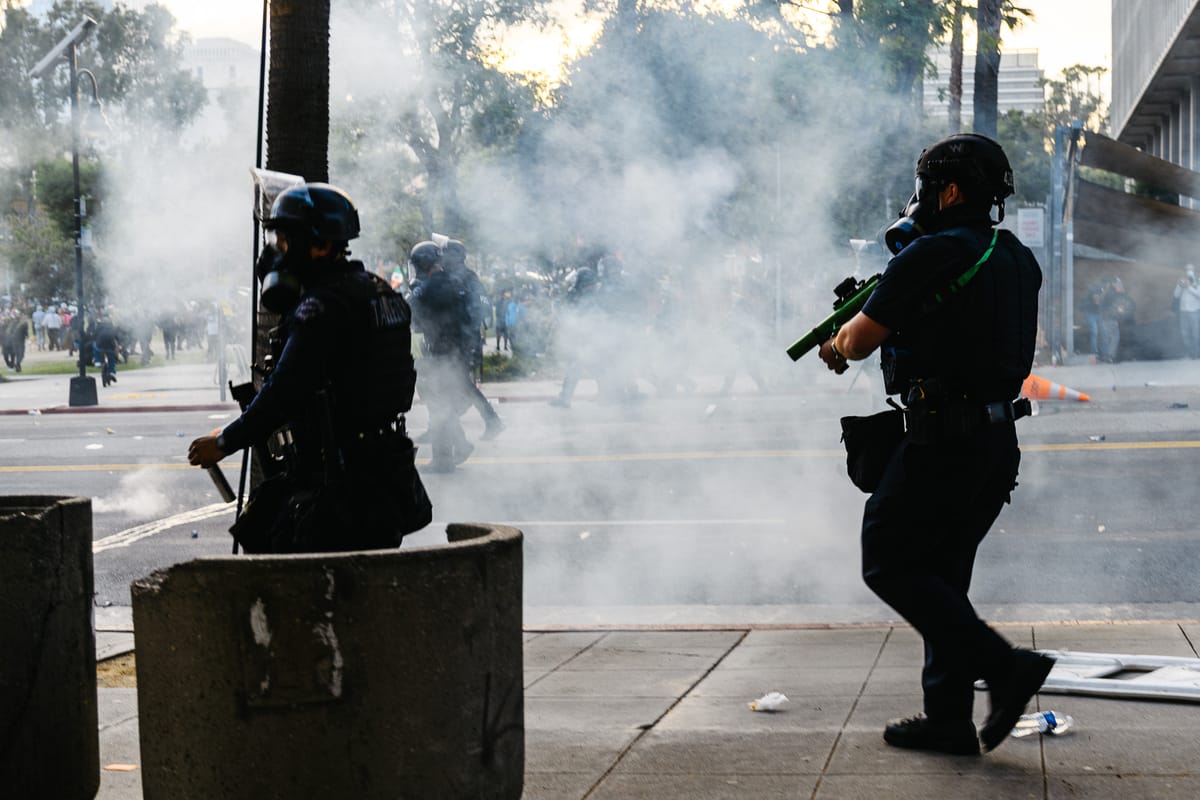
The use of tear gas at protests by LAPD is a rarity. A department spokesperson told LA Taco it hadn't been used for crowd control since the 1970's. The chemical irritants popped up at other demonstrations since the protests in June, including most recently at the Dodgers World Series celebration in Echo Park, where multiple people were injured by "less lethals" and nearly trampled by police on horses.
Informing the public
After calling Hugo’s amendment "uninformed public policy," Chief McDonnell said he hopes for an opportunity to educate the council and public on how the department uses their military equipment.
However, the department did not establish any public outreach initiatives or scheduled townhalls to allow the community to pose questions or provide feedback to the Chief and other department members regarding the report. Instead, the public’s only opportunity to speak out was at a Board of Police Commissioners meeting in November.
The law requires that within 30 days of submitting and publicly releasing the report, police are to hold, at a minimum, one well-publicized and convenient community meeting.
Instead, a person was expected to regularly review the agendas of Board of Police Commission meetings and be able to either attend the meeting in person or call in at 9:30 a.m. on a Tuesday to participate.
Their lack of community engagement was a key criticism in the Los Angeles Controller's audit of LAPD's compliance with AB481 last year.
A spokesperson for the Controller's office criticized the failure to address this recommendation, saying, "Presenting the report at Council or Board of Police Commissioners meetings is not the equivalent of the community engagement sessions contemplated by the law and recommendation."
Out of the 13 recommendations in the Controller's audit, only seven were either partially or fully implemented by the LAPD. Inventory audits and product descriptions, albeit in the form of URL links, made their way into the report as recommended.
Model behavior.
After listening to criticisms from councilmembers about the department’s response to the protests in June, McDonnell proudly told the council, “We have become a model for the country in managing crowd control situations."
Human Rights Watch, an organization whose work includes investigating war crimes, examined 65 cases in which the LAPD and other police agencies injured journalists and protesters during protests in June against the federal government's immigration raids. The organization called for departments to hold officers responsible for their excessive use of force.
A federal judge echoed similar findings when he placed an injunction on the department that prevents officers from firing projectiles at journalists and arresting or detaining them while covering protests.
In his ruling, Judge Hernán D. Vera cited the department's 20-year history of police violence at protests and a "cannonade of evidence," including videos, documented injuries, and declarations from journalists, of the LAPD violating journalists' civil rights and state law.
The city is appealing the injuction, and they will make the case in January in front of the 9th Circuit Court.
If other departments were to model their crowd control response after LAPD, their city's will need to budget for the hefty liability settlements that are likely to follow. The department has racked up $20 million in settlement payouts since 2019 in protest-related liability settlements.
Councilwoman Hernandez brought up the current fiscal impact the settlements are having on the city's budget crisis to McDonnell, with more to come in cases related to the department's violent response to the protests this year.
"You're trying to put a price on saving lives," rebutted the chief.
Room for improvement
For the LAPD, the report is another bureaucratic box to check off every year that gets rubber stamped by the Board of Police Commissioners and city council. This year was the first time the department faced any significant pushback on the report from the council.
City Council President Marquees Harris-Dawson had the last word before the vote and said, “I'm supportive of our officers, I'm supportive of the work we do, but this is not an area where there isn't room for great improvement."
The Chief's adversarial responses to legitimate criticisms about deploying tear gas in densely populated neighborhoods or firing 600 40-mm rubber bullets in a single day are a sign there's likely little openness for change.
The military equipment approval process is a rare opportunity for city council to dictate an LAPD policy, a responsibility that sits in the hands of the Board of Police Commissioners. Unless the police commissioners intervene, the city council must wait until next year's vote on LAPD's military equipment report to make any modifications to the department's policies.
The unanimous approvals to this year's military equipment report and Soto-Martinez's motion failing to pass now leave Angeleno's taking the streets this year vulnerable to the same police violence people have faced over the past two decades in this city.
The LAPD did not respond to questions for the story.

Of Note
You can watch the full exchange and vote here:
Some highlights include Soto-Martinez asking the McDonnell to make sense of how 1,000 rounds of munitions were used on specific targets as the law requires, to which the chief shrugged off by saying the munitions didn't hit their targets:
CM Soto-Martinez, who authored the amendment to limit less lethal use at protests, asks the Chief to make sense on how 1,000 rounds of munitions were used on specific targets as the law requires. Chief responds, "For you to come w/o seeing what we do to make these kind of charges, I'm troubled."
— Joey Scott (@joeyneverjoe.bsky.social) 2025-12-03T02:46:55.906Z
Soto-Martinez brought up AB48 as it relates to firing at journalists, including one incident caught live on air.
You can watch the incident here of Australian reporter Lauren Tomasi getting hit by an officer.
CM Soto-Martinez points out that the department was caught on TV shooting an Australian journalist with a “less lethal” live on air. Chief McDonnell dismisses the incident and said there’s more to it than what was shown on TV.
— Joey Scott (@joeyneverjoe.bsky.social) 2025-12-03T03:58:27.622Z
I wrote about the number of munitions used in June here:
 Joey Scott
The department is likely violating state law AB48 by failing to disclose their use of force at the No King's protest.
 Joey Scott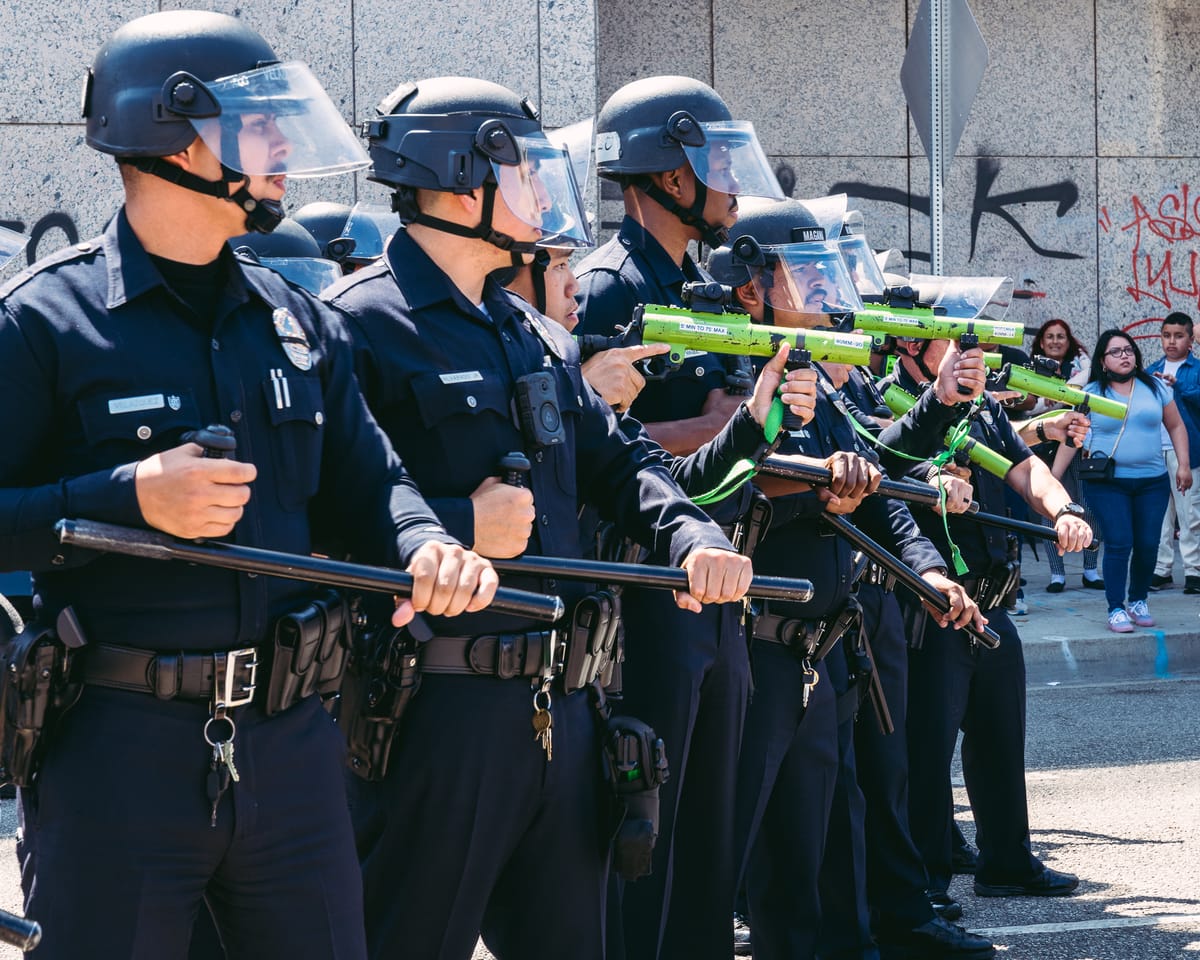

If you appreciated this story or any of my other work, you can buy me a coffee, a Diet Coke, or cover a handful of public records requests. I'll even help file one for you!